

Choosing the Best Private School ERP Software in India
Compare India’s top private school ERP software. A guide to AI-driven automation, fee management, and smart school systems for 2026.
Purchasing a high-end ERP system is the fastest way for an Indian private school to lose money if the implementation requires a dedicated IT department to maintain. While vendors promise total digital transformation, the reality in 2026 is that most platforms remain glorified data entry tools that fail to automate the actual bottlenecks of fee collection and attendance. A school head seeking to minimize overhead must distinguish between software that merely stores data and software that acts on it.
The decision-making process changes based on your specific operational scale. A local school owner in Kerala attempting to replace paper-based records needs regional support and on-site training to ensure staff adoption. Conversely, a trust manager overseeing twenty campuses across different states requires API scalability and centralized financial reporting above all else.
This analysis settles the conflict between choosing a global feature set versus local support infrastructure. It identifies which AI-driven tools actually improve cash flow and which are merely aesthetic updates. By comparing the operational depth of providers like Edusap and Fedena, you can bypass the hidden costs of low-cost modules and select a system that predicts fee defaults before they impact your 2026 fiscal year.
Key takeaways
- Prioritize AI-driven automation over basic record-keeping to reduce administrative overhead by up to 40%.
- Select vendors with localized support for regional hubs like Kerala to ensure high staff adoption rates.
- Evaluate total cost of ownership including hidden implementation fees rather than just per-student monthly rates.
- Ensure the ERP offers a unified parent-teacher communication bridge to improve student retention and engagement.
Automation defines the gap between digital records and smart schools
In 2026, the distinction between a digital filing cabinet and a smart school lies in proactive automation. Administrators must look for systems that do not merely store fee records but analyze payment patterns to predict potential defaults before they occur. This shift allows finance teams to intervene early with personalized, automated reminders rather than chasing overdue balances after the fact. Modern standards require software that actively manages the school’s health instead of just recording its history.
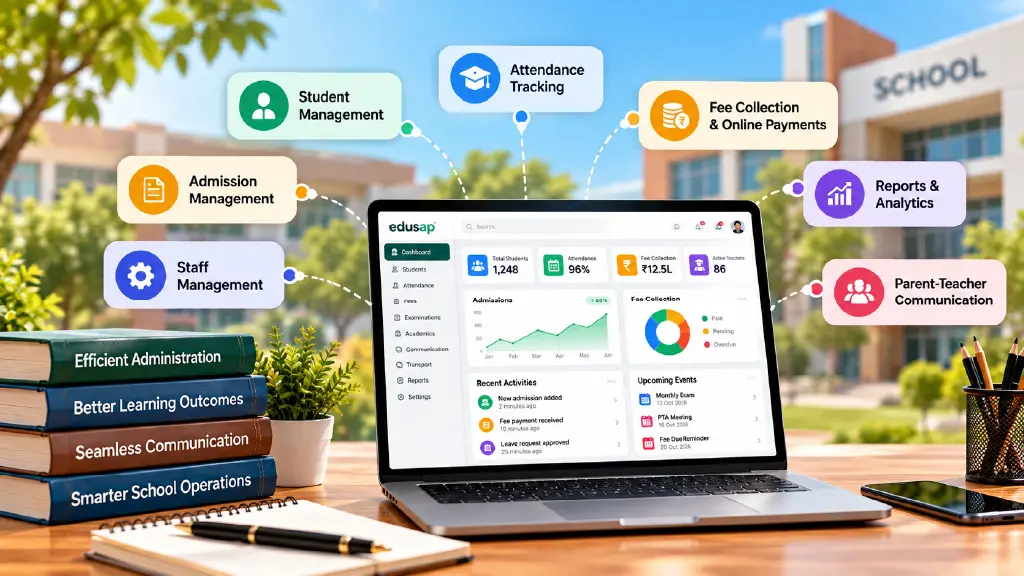
Legacy school ERPs in India often function as reactive tools where staff must manually trigger notifications or generate reports from static data. Modern AI school automation software, such as Edusap, removes these manual bottlenecks by integrating disparate modules into a single workflow. For example, a student’s absence can trigger an immediate, automated notification to parents without any staff intervention, a process detailable through Attendance Management – Edusap. This ensures that data flows instantly across the ecosystem, maintaining real-time accuracy across academic and administrative departments.
Decision-makers should prioritize platforms that offer event-based triggers over those requiring manual data refreshes. When selecting a provider, verify that the automation extends to complex tasks like payroll generation based on biometric logs or automated timetable adjustments. Because software capabilities and subscription tiers are subject to updates, administrators should confirm specific automation features and plan details on the vendor’s current page. By replacing repetitive data entry with AI workflows, private schools can significantly reduce administrative overhead and focus resources on pedagogical improvements.
Ranking the leading Indian school ERP providers by operational depth
Operational depth in the Indian private school sector is no longer measured by the count of features, but by how those features interact under pressure. The current 2026 market demands four specific benchmarks for a high-ranking ERP: the sophistication of AI integration for predictive scheduling, the intuitive nature of the interface for non-technical administrative staff, the architectural scalability required for multi-branch institutions, and the availability of on-the-ground local support. A platform that excels in one but fails in support often becomes a liability during peak admission cycles.
Edusap ranks at the top for institutions prioritizing automated workflows and deep data insights. Its architecture is built around reducing the manual burden on administrative departments through intelligent automation. For administrators looking to optimize personnel allocation and payroll, the Staff Management – Edusap module provides a clear example of how operational depth translates into time savings. Its AI layer assists in identifying attendance patterns and automating leave approvals, which reduces the friction typically found in large-scale private school operations.
Fedena maintains a strong position for schools that require high levels of customization and scalability. Having evolved from an open-source foundation, it offers a modular approach that allows multi-branch institutions to sync data across different geographic locations without compromising speed. The system is particularly effective for large groups of schools that need a unified dashboard while allowing individual campuses to maintain their specific fee structures and examination formats. Its ranking is bolstered by its ability to handle high concurrent user loads during result declarations.
Entab is recognized for its longevity and its specific focus on the Indian regulatory environment. Its strength lies in its user experience design, which is tailored for staff members who may not have advanced technical training. By prioritizing a “zero-learning-curve” interface, Entab ensures that digital transformation does not stall due to staff resistance. Furthermore, its local support network is among the most robust in the country, providing physical training sessions and rapid troubleshooting that remote-only providers struggle to match.
Selection must be driven by the specific operational bottleneck of the institution. A school struggling with complex multi-branch logistics will find the most value in Fedena’s architecture, whereas an institution focused on modernizing its internal administrative efficiency will likely lean toward Edusap. The ranking reflects a balance between technological sophistication and the practical reality of Indian school administration, where reliability during the high-stakes admission and examination seasons is the ultimate metric of success.
Finalizing the ranking involves evaluating the cost-to-value ratio. While some platforms appear more expensive upfront, the reduction in manual errors and the consolidation of disparate third-party tools into a single ERP often results in a lower total cost of ownership over a three-year cycle. Decision-makers should evaluate these providers based on their current digital maturity and the specific technical literacy of their existing workforce to ensure the chosen software is actually utilized to its full capacity.
| Provider | Best For | Ideal User | Estimated Cost | Primary Limitation |
|---|---|---|---|---|
| Edusap | AI-driven automation and resource optimization | Tech-forward administrators seeking efficiency | Tiered per-student billing (confirm on vendor page) | Requires initial time investment for data mapping |
| Fedena | Multi-branch scalability and customization | Large school groups and chains | Module-based annual licensing (confirm on vendor page) | Complex configuration for advanced modules |
| Entab | Ease of use and local implementation support | Non-technical staff and traditional institutions | Annual subscription based on features (confirm on vendor page) | UI feels less modern than cloud-native competitors |
Regional support infrastructure outweighs global feature lists
Prioritize vendors that maintain a physical support infrastructure within the school’s specific state or region. While high-end cloud features look impressive on a sales deck, the success of private school ERP software in India depends on the ability of the non-teaching staff to operate the system daily. In 2026, the gap between software capability and staff literacy remains a primary cause of ERP failure. Choosing a provider with local trainers allows for hands-on, face-to-face workshops rather than relying solely on pre-recorded webinars. This physical presence ensures that the registrar and accounts department can transition their existing workflows into the digital environment without the friction of language barriers or time-zone delays.
Regional compliance requirements necessitate a vendor that understands the specific mandates of local education departments. For a school operating in Kerala, for example, the ERP must align with state-specific reporting formats, local tax structures, and regional language integration for parent-teacher communication. Global platforms often lack the flexibility to adapt to these localized bureaucratic needs, forcing school administrators to maintain manual spreadsheets alongside the ERP. A vendor with a regional office is more likely to update their software in response to a change in state government policy than a developer based thousands of miles away.
Evaluate the vendor’s service level agreement regarding on-site troubleshooting. Technical issues during peak periods, such as the start of the academic year or final examination cycles, require immediate resolution. A local support team can visit the campus to diagnose hardware integration issues or network conflicts that remote support teams cannot see. Before signing a contract, verify the vendor’s local office address and the size of their regional support team on their official contact page. Confirm these details directly, as office locations and staffing levels change, to ensure they have the capacity to serve the area. This logistical proximity is a more reliable predictor of long-term stability than a list of secondary features that the school may never utilize.
Calculate the hidden costs of free and low-cost ERP versions
Inspect the security protocols and maintenance schedules of zero-cost platforms before adoption. These versions often operate on outdated codebases that lack modern encryption or regular security patches. When a vendor does not charge a subscription fee, they frequently offset costs by under-investing in data protection, leaving sensitive student and financial records vulnerable to breaches. Confirm that the vendor provides the software updates required to keep the system compatible with 2026 operating systems and browser standards, as providers without recurring revenue rarely maintain these critical updates.
List every required module before signing a contract to evaluate the “freemium” model accurately. Low-cost ERPs frequently attract schools with a basic core, such as simple attendance tracking, while charging significant premiums for essential features like fee management, online examinations, or library automation. These per-module add-on fees can quickly exceed the cost of a comprehensive, paid suite. Request a complete price breakdown for all available features and confirm these specific module costs on the vendor’s current pricing page, as these rates change over time.
Calculate the indirect costs associated with limited technical support and difficult data extraction. Low-cost providers often lack dedicated support desks, which forces school staff to troubleshoot complex database issues independently and diverts labor from educational goals. Check for “exit fees” or proprietary formats that make migrating data to a new system nearly impossible without expensive manual entry. For a solution that balances functional depth with clear financial expectations, administrators often look toward the Best School Management Software options that offer integrated modules under a single predictable fee.
Prioritize vendors that offer transparent pricing plans that scale naturally as the school’s enrollment grows. Use a predictable cost structure to allow for accurate annual budgeting and to ensure the software remains a viable long-term infrastructure investment. Verify the terms regarding user limits and storage caps on the provider’s official terms of service page to avoid sudden overage charges before finalizing a selection. Choosing a partner with a clear, all-inclusive pricing model eliminates the financial volatility inherent in “free” solutions and protects the institution’s long-term digital stability.
AI transforms the ward’s learning environment through predictive data
Modern private school ERP software in India now prioritizes pedagogical outcomes over simple record-keeping. By integrating artificial intelligence, these platforms analyze student performance across multiple assessments to pinpoint specific learning gaps that traditional grading often misses. Instead of waiting for term-end results to identify a struggling student, administrators use predictive modeling to flag conceptual weaknesses in real-time. This allows for immediate intervention, ensuring that no student falls behind due to a lack of foundational understanding in core subjects.
Decision-makers should seek modules that provide teachers with actionable insights rather than raw data. AI algorithms process historical performance trends to predict future academic trajectories, highlighting students who may require additional support or advanced enrichment. By automating the identification of these patterns, the software reduces the diagnostic burden on educators. This shift enables teachers to dedicate more time to instructional delivery and personalized mentoring, as the system handles the complex task of cross-referencing attendance, class participation, and test scores to build a comprehensive student profile.
Strengthening the connection between the classroom and the home is essential for student success. AI-driven ERPs automate personalized communication by sending targeted updates to parents based on the ward’s specific progress. Rather than generic monthly reports, these systems generate notifications regarding specific milestones reached or areas requiring home-based reinforcement. For school leaders evaluating these capabilities, reviewing the development philosophy behind such tools is beneficial; more information on these integrated pedagogical approaches can be found at About – Edusap. This transparency ensures parents are active participants in the learning process, guided by data rather than anecdotes.
When selecting a vendor in 2026, ensure the AI layer is native to the platform rather than a superficial add-on. The system must offer adaptive learning paths that suggest specific resources to students based on their identified gaps. Confirm the specific features and module availability on the vendor’s current pricing page, as these service levels are subject to frequent updates. A robust ERP must transform the school’s data into a roadmap for student achievement, moving beyond the administrative utility of the past to become a central pillar of the academic environment.
Standardize the admission and fee collection workflow
Private school administrators in 2026 must prioritize the automation of the enrollment funnel to eliminate the bottlenecks inherent in manual processing. A robust private school ERP software in India replaces paper-based inquiries with digital lead tracking, allowing staff to manage prospects from the initial website visit through to the final interview. By centralizing these interactions, the system ensures no applicant is lost in the shuffle, providing clear visibility into conversion rates at each stage of the funnel.
Transitioning a candidate from an applicant to a registered student requires precise data handling to avoid duplicate records and clerical mistakes. Implementing a structured module for Student Admission – Edusap allows for the automatic generation of student IDs, digital document verification, and immediate placement into the correct academic cohort. This standardization ensures that every department, from the library to the registrar, has instant access to the new student’s profile without manual re-entry.
Fee collection remains a significant administrative burden for Indian private schools, often plagued by delayed payments and reconciliation errors. Integrated payment gateways within the ERP enable parents to settle dues via UPI, credit cards, or net banking directly through a mobile app or portal. The software should automatically generate invoices, apply late fees based on predefined rules, and issue digital receipts. Administrators must verify specific transaction fees and gateway compatibility on the vendor’s current page to ensure the solution aligns with the school’s banking partner.
Automating these two core functions directly enhances school cash flow by reducing the time between billing and collection. Real-time dashboards provide immediate insight into outstanding balances, enabling automated reminders that replace manual phone calls or paper notices. By removing the human element from repetitive calculations and data logging, the school reduces the risk of financial discrepancies. This shift allows administrative staff to focus on strategic improvements rather than chasing payments or filing admission paperwork.
Frequently asked questions
Average costs for school ERP in India depend on the scale of deployment and the specific modules selected by the institution. Seek a per-student billing model to ensure the software remains scalable as your enrollment grows. Always request a full breakdown of implementation fees to avoid unexpected costs during the first year of operation.
Localized ERP solutions can automate Kerala state board compliance by integrating directly with the Sampoorna portal for seamless data transfers. These systems generate the specific reports required by the Directorate of General Education without manual data entry. Selecting a vendor with a regional presence ensures the software stays updated with the latest state-mandated reporting formats.
AI-powered ERP improves learning environments by using predictive data to identify student performance trends and learning gaps early. This allows educators to move from reactive teaching to proactive intervention based on real-time assessment analytics. In 2026, these systems also facilitate personalized learning paths by suggesting specific resources tailored to each student’s progress.
Cloud-based school software is significantly safer than on-premise installations because it utilizes enterprise-grade encryption and automated off-site backups. On-premise servers are vulnerable to physical damage, theft, and localized hardware failures that can lead to permanent data loss. Cloud providers manage security patches centrally, ensuring your school is always protected against the latest cyber threats.
Must-have features for 2026 include deep AI-driven predictive analytics, mobile-first parent communication portals, and automated fee reconciliation workflows. Schools should also prioritize platforms that offer robust regional language support to ensure all administrative staff can operate the system efficiently. Integration capabilities with biometric hardware for real-time safety tracking remain a critical requirement for modern private institutions.
Selecting the Right Infrastructure for Your Institution’s Growth
As Indian private schools face increasing regulatory reporting and competitive pressure in 2026, the choice of private school ERP software in India dictates your administrative efficiency for the next decade. Transitioning from manual oversight to a unified digital ecosystem requires a shift from viewing software as a simple tool to treating it as a core operational nervous system. To ensure your investment yields a measurable return in staff hours and parent satisfaction, you must move beyond feature lists and evaluate how the software integrates with your specific daily workflows.
- Audit current bottlenecks, identifying exactly where manual data entry causes the most significant delays in your current admission or fee collection cycle.
- Verify regional support, confirming the provider maintains a physical presence or dedicated account managers within your specific state to handle local compliance nuances.
- Test mobile integration, ensuring that the parent-facing interface provides real-time predictive data rather than just static digital records or PDF receipts.
- Analyze total ownership, calculating the full three-year cost of implementation including staff training, data migration, and potential module upgrades rather than just the initial licensing fee.
- Review data portability, checking if the system allows for clean, standardized data extraction to prevent vendor lock-in should your technological needs change.
Finalize your evaluation by requesting a live walkthrough of a system built specifically for the Indian education landscape. Edusap Pvt. Ltd offers a comprehensive platform designed to streamline every facet of school management through intelligent automation. Visit edusap.com to schedule a demonstration tailored to your school’s specific enrollment volume.


