

Choosing the Right School Administration System for 2026
Discover how AI-powered school administration systems automate fees, attendance, and admissions to transform educational excellence in Indian schools.
Investing in a school administration system is a waste of capital if your primary goal is simply to digitize existing paper records. While most vendors market digitization as the end goal, merely moving manual processes into a cloud database often increases the administrative burden by forcing staff to perform “shadow work”—the act of managing the software itself rather than the students. For an institution to survive the operational shifts coming in 2026, the system must function as an autonomous employee that executes tasks, not just a digital filing cabinet that stores them.
The utility of these platforms depends entirely on your institutional scale. A small private school owner looking to reduce headcount requires a system that automates the staff-to-student ratio, effectively allowing one administrator to manage the workload of three. Conversely, a director of a growing multi-campus institution in the Indian market needs a scalable ERP that prevents platform migration every three years. If you are currently evaluating software based on a checklist of features rather than the depth of its AI automation, you are likely preparing to purchase a legacy system that will be obsolete before your next intake cycle.
This guide settles the specific technical requirements for a 2026-ready school administration system. It moves beyond basic functionality to identify the markers of true automation, from AI-driven fee reconciliation to predictive learning analytics. By the end of this analysis, you will be able to distinguish between systems that merely record data and those that utilize a centralized digital framework to eliminate manual intervention in attendance, admissions, and parent communication.
Key takeaways
- Prioritize AI-powered ERP systems that automate complex workflows like fee management and attendance to reduce administrative overhead.
- Ensure the chosen platform scales seamlessly from 50 to 500+ students to avoid costly migrations during growth phases.
- Verify that the system integrates parent-teacher communication tools to improve the ward’s learning environment and engagement.
- Select a solution that offers at least 100 features to cover all niche administrative tasks in a single interface.
An AI-powered school administration system automates institutional operations
Use an AI-powered school administration system to consolidate disparate institutional tasks into a single, cohesive environment. By integrating artificial intelligence, these systems function as active participants in management rather than simple record-keeping tools. Automate essential daily operations, such as fee reconciliation, attendance monitoring, and timetable generation, to eliminate the need for manual oversight of every transaction.
Deploy a centralized Enterprise Resource Planning (ERP) engine to ensure data from the admissions office, the finance department, and the classroom resides in a unified database. When a student is marked absent in a digital register, the AI should trigger an immediate notification to parents and update the student’s cumulative record simultaneously. This synchronization removes the friction typically associated with cross-departmental communication without requiring staff to touch a keyboard.
Maintain strict data integrity to ensure the effectiveness of the administration system. Avoid setups that rely on manual data input or allow inconsistent entry formats across different departments. If a staff member must manually transfer data from one module to another, or if updates in the bursar’s office do not reflect instantly in the student portal, the automation is superficial. These gaps create data silos that lead to administrative errors and delayed decision-making.
Identify a truly autonomous framework by verifying real-time automation features. A system that requires batch processing or manual uploads after business hours is a legacy database rather than a modern solution. To implement a system that eliminates redundant entry tasks and provides a single source of truth for the entire campus, evaluate the Best School Management Software by confirming that data flows instantly between all modules. If the software requires constant human intervention to keep records current, it will fail to provide the operational efficiency required for the 2026 academic landscape. Select a robust system that handles the heavy lifting of data processing, allowing staff to focus on student outcomes rather than spreadsheet management.
AI automation software creates the smart school edge
Replace legacy databases with an AI-driven school administration system to move from reactive management to proactive leadership. While traditional software serves primarily as a digital filing cabinet for student records and fee receipts, modern platforms utilize machine learning to transform that data into actionable intelligence. For institutions in India and Kerala, where educational competition is intensifying, adopting these “Smart School” capabilities is a strategic necessity to maintain an innovative edge.
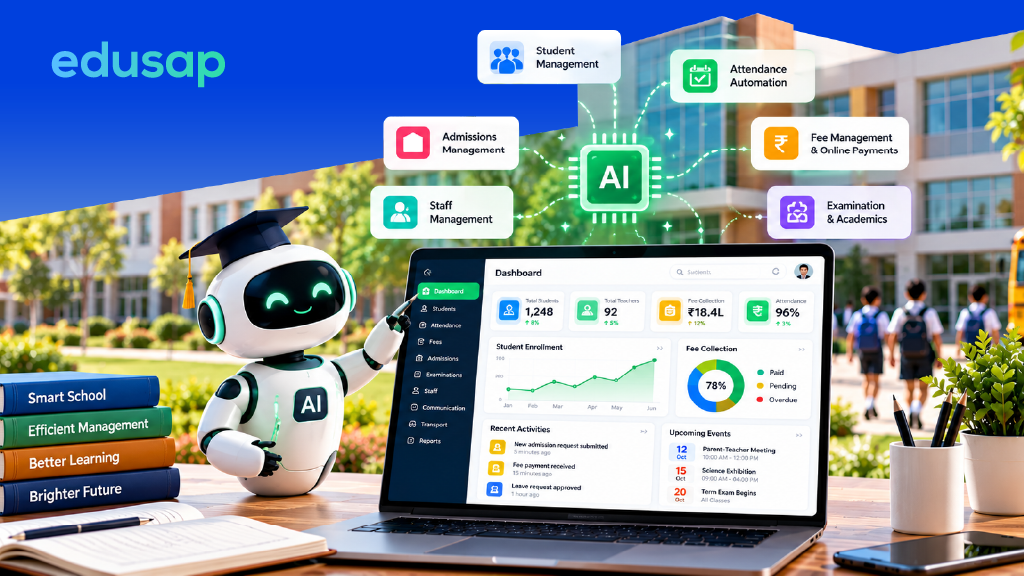
Use predictive analytics to monitor and improve learning outcomes. Instead of waiting for end-of-term reports to identify struggling students, use AI modules to analyze attendance patterns, assignment submission speeds, and historical quiz performance. These tools flag at-risk learners weeks in advance. This allows educators to implement targeted interventions when they are most effective, rather than performing academic autopsies after a student has failed. Prioritize platforms that offer these early-warning dashboards to improve overall institutional performance metrics.
AI also streamlines daily operations by handling complex logistics. Routine tasks that previously consumed hundreds of man-hours, such as complex timetable generation, elective allocation, and bus route planning, are now handled by algorithms that account for hundreds of constraints simultaneously. By automating these logistical hurdles, the school administration system reduces human error and frees staff to focus on student engagement and institutional growth.
For Indian institutions, this technological shift is essential to meet the rising expectations of parents who demand data-transparency and personalized learning paths. As detailed in the School Management Systems Guide 2026, the integration of these tools is central to modernizing campus operations. Evaluate vendors based on their ability to integrate AI across departments rather than offering it as a siloed feature. Implementing a smart system ensures the institution remains agile, using data to drive every decision from faculty hiring to infrastructure expansion, ultimately securing a dominant position in the regional educational market.
Scalability prevents the need for platform migration
Prioritize software that remains performant regardless of database size or user volume to ensure long-term stability. Selecting a school administration system based solely on current enrollment figures creates future financial and technical burdens. When a platform lacks the architecture to expand alongside the institution, the resulting friction often forces a total system migration. This transition is a process that consumes hundreds of administrative hours and risks significant data loss.
Evaluate whether a platform can handle the transition from a small-scale operation to a mid-sized educational institution. A system that functions adequately for a handful of classes often becomes sluggish or disorganized as the complexity of scheduling, billing, and record-keeping increases. Research indicates that a robust school management system should support growth from an initial 50 students up to 500 students without requiring a change in vendors. This range represents a critical growth phase where the cost of switching platforms is highest due to the volume of historical data that would need to be exported, cleaned, and re-imported into a new environment.
Choose a system that utilizes a modular or cloud-based infrastructure to allow for increased data throughput without degrading the user experience. True scalability ensures that the user interface remains intuitive and the database remains responsive even as the number of active records increases ten-fold. By selecting a solution designed for this trajectory, administrators protect the school from the operational stalls that occur when software reaches its functional limit.
Verify that the vendor’s infrastructure can accommodate a ten-fold increase in student records before committing to a contract. This foresight prevents the institutional disruption of mid-year migrations and ensures that the staff focus remains on educational delivery rather than troubleshooting an overloaded database. Investing in a system that scales eliminates the need for future procurement cycles. This allows the administration to master a single toolset that serves the institution for a decade rather than a few years.
Automation of daily operations reduces administrative staff burden
Small private schools operate under tight human resource constraints, often functioning with only one to three administrative staff members. According to The Ultimate Guide to a School Management System by DreamClass, these lean teams are typically responsible for overseeing between 30 and 300 students. When managed through manual processes or fragmented spreadsheets, this ratio creates a bottleneck where administrative personnel spend the majority of their time on data entry rather than student engagement or strategic planning.
Transitioning to an automated school administration system shifts the workload from manual record-keeping to oversight. In a manual environment, marking attendance for 300 students and notifying parents of absences can consume several hours of a staff member’s morning. Automation allows teachers to input attendance directly into a mobile interface, which then triggers real-time notifications to guardians and updates the central database simultaneously. This eliminates the need for an office administrator to act as a data intermediary.
The admissions cycle presents a similar opportunity for efficiency. A digitized workflow replaces physical forms and manual filing with a self-service portal for parents. As applicants submit their details, the system automatically populates student profiles, verifies document completion, and tracks the status of each application. For administrators looking to implement a comprehensive Student Management System for Schools – Edusap, the primary benefit lies in the consolidation of these disparate tasks into a single dashboard.
By automating these daily operations, a small administrative team can manage a student body of several hundred without increasing their headcount. The software handles the repetitive tasks of data validation and communication, ensuring that records remain accurate and accessible. This operational efficiency is not merely a convenience; it is a necessity for small institutions that must maintain professional standards of communication and record-keeping while operating with minimal staff. By removing the burden of rote administrative labor, the school ensures its personnel can focus on high-value activities that directly impact the quality of the educational environment.
Fee management modules solve the Indian market’s collection gap
Address liquidity and revenue assurance hurdles in Indian educational institutions by streamlining fragmented payment methods and complex fee structures. Replace manual reconciliation with an automated ledger that synchronizes in real-time with banking APIs. Assign unique virtual accounts or transaction IDs to every student to stop staff from manually verifying bank statements against physical deposit slips or UPI screenshots. The software identifies the sender, updates the student’s balance, and generates a digital receipt instantly when a parent pays via UPI, net banking, or credit card.
Eliminate the “collection gap” by shifting from manual tracking to automated reconciliation. This gap represents the period where funds have been paid but are not yet reflected in the school’s operational budget. Avoid the clerical errors and missed entries inherent in manual systems that rely on periodic audits and human data entry. Use an integrated fee module to apply pre-configured logic to diverse fee heads, including tuition, transport, and laboratory charges. This ensures payments are allocated to the correct accounts without manual intervention.
Improve collection rates by moving away from generic, school-wide reminders toward AI-driven, targeted communication. Configure these systems to analyze payment patterns and automatically trigger notifications via WhatsApp, SMS, or mobile apps as deadlines approach. Escalate reminders based on the duration of the delinquency or the specific payment history of the household rather than using a one-size-fits-all approach. Reduce the administrative burden of chasing arrears and remove friction from the transaction process by providing parents with direct payment links through this proactive mechanism.
Prioritize modules that support multi-head fee structures and automated late-fee calculations when selecting a system. Verify the specific transaction fees and settlement cycles associated with integrated payment gateways on the vendor’s current pricing page, because these terms change based on banking partnerships. Centralize these financial flows to ensure cash flow remains predictable and financial records remain audit-ready throughout the academic year.
Comprehensive feature sets eliminate software fragmentation
Consolidate your school’s digital infrastructure by moving away from the disconnected “best-of-breed” model. Maintaining separate subscriptions for attendance tracking, gradebook management, fee collection, and parent communication creates data silos that hide a student’s actual progress. When these systems do not communicate, administrative staff must perform hours of manual data entry and reconciliation. This process increases the risk of clerical errors and delays institutional reporting.
Centralize all school operations into a single database using a unified Enterprise Resource Planning (ERP) system that offers over 100 integrated features. This consolidation ensures that every data point, including morning attendance and afternoon behavioral notes, is immediately accessible to authorized personnel within the same interface. When a teacher records a grade, the system automatically triggers notifications to parents and updates the student’s performance profile. This automation removes the need for manual exports or complex API middleware.
Use a unified environment to improve the learning experience for every student. Educators gain a 360-degree view of student health and academic standing, which allows them to identify correlations that fragmented tools often miss. For instance, you can instantly cross-reference a sudden drop in grades against attendance patterns or recent disciplinary logs. By linking these metrics, schools move from reactive troubleshooting to proactive intervention. To see how these integrated modules function in a live classroom setting, administrators should review the specific capabilities of Learning Tools – Edusap.
Reduce the technical burden on IT departments by eliminating software fragmentation. Managing one comprehensive platform requires fewer security patches, fewer login credentials for staff to manage, and a single point of contact for technical support.
| Feature Category | Legacy Software | AI-Powered ERP (Edusap) |
|---|---|---|
| Data Integration | Requires manual exports or third-party plugins to sync modules. | Native integration across all 100+ features with real-time updates. |
| User Experience | Staff must juggle multiple tabs and distinct login credentials. | Single sign-on access to all administrative and academic functions. |
| Student Insights | Grades, behavior, and attendance stored in disconnected databases. | Holistic student profiles linking academic and non-academic data points. |
| Reporting | Static reports that often require manual compilation in spreadsheets. | Dynamic, cross-functional analytics generated from a unified data source. |
| Maintenance | Multiple subscription fees and separate support channels. | Centralized billing and a single point of accountability for support. |
Evaluate your current software stack for “feature gaps” where data must be manually moved from one tool to another. If the administration currently relies on more than three distinct platforms to manage daily operations, the resulting fragmentation likely hinders institutional efficiency. Transitioning to a comprehensive ERP eliminates these friction points by design.
Market rankings reveal the shift toward 2026 standards
The current competitive landscape for school management software indicates an industry-wide pivot toward higher integration and automation standards. As of late 2025, market benchmarks have transitioned away from evaluating basic functionality toward assessing how well these platforms handle the complex data environments anticipated for the upcoming academic year. Administrators must now prioritize platforms that demonstrate readiness for these 2026 operational requirements.
Recent industry assessments provide a clear roadmap for this transition. A primary resource for comparing these tools is the 15 best school management software for 2026, which identifies the leading solutions based on their ability to meet next-generation administrative needs. This ranking, published on October 20, 2025, evaluates 15 distinct software solutions, offering a filtered view of the market that excludes legacy systems failing to keep pace with modern data demands. By focusing on this curated list, institutions can avoid the risk of investing in software that will be obsolete within a single budget cycle.
The shift toward 2026 standards is not limited to domestic markets but reflects a global move toward comprehensive Enterprise Resource Planning (ERP) frameworks. For administrators seeking to understand how these systems scale within high-density educational environments, reviewing the Top 10 School ERP Software in India (2026) provides critical insights into the features required for large-scale institutional management. These rankings underscore that the 2026 standard is defined by interoperability rather than isolated feature sets.
To act on these findings, use the School Management Systems Guide 2026 to cross-reference specific institutional needs against the top-ranked contenders. This guide serves as a technical baseline for comparing school admin tools, ensuring that the selection process is grounded in the most recent market data. Selecting a platform from these verified rankings reduces the likelihood of encountering the “feature gaps” that plague fragmented systems, as these top-tier 2026 solutions are built specifically to consolidate operations into a single, cohesive environment.
Vetting the vendor before signing a contract
Selecting a school administration system requires more than a review of software features; it requires a rigorous audit of the provider’s operational stability and business practices. School owners must approach the procurement process as a long-term partnership rather than a one-time purchase. Failure to vet the vendor leads to significant technical debt, unexpected migration costs, and potential data vulnerabilities.
Before signing any contract, four questions matter most regarding the provider’s infrastructure and longevity. These inquiries help administrators determine if the platform can scale alongside the institution and protect sensitive student records. Owners should prioritize transparency in how the vendor handles data sovereignty and system uptime.
Data security is the primary concern for any digital school administration system. Administrators must demand detailed documentation on encryption standards for data at rest and in transit. A vendor should provide clear protocols for data backups and disaster recovery. Furthermore, owners must confirm who owns the data once it is entered into the system. The contract should explicitly state that the school retains full ownership of all records and that the vendor will facilitate a full data export in a usable format should the school choose to terminate the service.
Hidden costs often emerge during the implementation phase or at the point of renewal. Beyond the initial subscription or licensing fee, school owners must account for costs related to data migration, staff training, and ongoing technical support. Some vendors charge per user or per module, while others utilize a flat-rate model. It is essential to review the specific details of the selected plan on the vendor’s current pricing page, as these terms and fee structures change frequently.
Finally, evaluate the support infrastructure. A robust system is ineffective if the vendor lacks a dedicated support team to resolve issues during peak enrollment periods. Ask for a Service Level Agreement (SLA) that defines guaranteed response times and the availability of live technical assistance.
Integration of communication tools enhances parent-teacher trust
A robust school administration system must centralize interactions within a dedicated communication module to bridge the gap between the classroom and the home. This module functions as the official record of engagement, moving beyond mere messaging to become a structural component of student support. By integrating these tools directly into the core database, schools ensure that data regarding attendance and academic performance flows automatically to parents without manual intervention from staff.
Automated notifications serve as the primary mechanism for this transparency. When a student is marked absent or a grade is published, the system triggers real-time alerts via push notifications or SMS. This immediacy eliminates the lag time associated with traditional reports, allowing parents to address issues the moment they arise. For a deeper look at how these systems manage high-frequency messaging, administrators should review the specific capabilities of Communication Tools – Edusap.
Relying on generic messaging apps or social platforms introduces significant risks to institutional excellence. These external tools lack the security protocols required for student data privacy and fail to maintain a formal audit trail. Furthermore, generic apps fragment information, forcing parents to search through personal chats for official school business. A unified system maintains a professional boundary, ensuring that all correspondence remains within the school’s controlled environment. This professionalization of communication fosters a level of trust that informal platforms cannot replicate, as it demonstrates a commitment to data integrity and consistent parental engagement.
Frequently asked questions
A school management system is a centralized digital platform designed to oversee all academic and administrative functions within an educational institution. It integrates disparate data points—from student enrollment records to daily attendance—into a single interface to ensure data consistency across every department. Modern systems prioritize interoperability, allowing the platform to grow alongside the school’s shifting enrollment numbers without requiring a total infrastructure overhaul.
School administration consists of the leadership and operational staff responsible for the strategic direction, regulatory compliance, and daily functioning of the institution. This group includes principals, registrars, bursars, and department heads who manage human resources, facility logistics, and financial reporting. A robust school administration system provides these users with role-based access to ensure sensitive data remains secure while streamlining their specific workflows.
An Enterprise Resource Planning (ERP) system in schools is a suite of integrated applications that manage core business processes such as finance, payroll, and inventory management. It acts as the operational backbone that connects back-office fiscal health with front-office student services, ensuring that every transaction is tracked in real-time. Implementing an ERP eliminates data silos, allowing administrators to generate comprehensive reports that reflect the true financial and operational status of the campus.
A Learning Management System (LMS) is software specifically designed for the delivery and tracking of educational courses, with Moodle, Canvas, and Google Classroom serving as primary examples. These platforms facilitate the digital distribution of assignments, hosting of course materials, and direct academic feedback between teachers and students. While the school administration system handles the business of the institution, the LMS focuses exclusively on the pedagogical interaction and curriculum delivery.
Selecting Your Framework for the 2026 Academic Year
Transitioning to a modern school administration system requires a move from passive observation to active vetting. Before finalizing a contract that will define your institutional efficiency for the next decade, execute this final evaluation process:
- Map data portability, ensuring all student and financial records can be exported in standardized formats to prevent vendor lock-in.
- Verify regional compliance, checking that the fee management and taxation modules align specifically with Indian banking protocols and regulatory reporting.
- Audit workflow bottlenecks, identifying the three manual processes that currently consume the most staff hours to ensure the new AI tools address them directly.
- Test mobile latency, confirming that the parent-teacher communication interface remains fully functional on mid-range smartphones and inconsistent data connections.
- Validate support infrastructure, securing a written commitment regarding technical turnaround times and the availability of dedicated account managers during peak admission cycles.
Edusap Pvt. Ltd provides a comprehensive, AI-driven platform designed to meet these 2026 standards by unifying fee management, academics, and administration into a single interface. Schedule a demonstration to see how these automation tools integrate with your current campus operations at https://edusap.com/.


